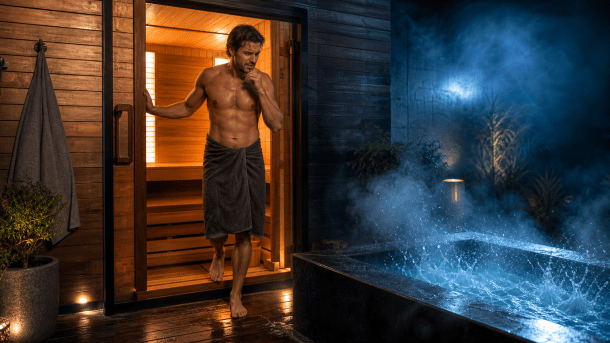
The sauna-to-cold-plunge ritual has become one of the most iconic wellness routines of the 2020s, popularized by biohackers, athletes, and podcasters alike. The logic seems unassailable: heat opens blood vessels, cold closes them, and the contrast pumps blood through your body like a cardiovascular piston. But a growing body of research is complicating this picture — particularly for people who train hard and care about muscle adaptation.
The Anabolic Blunting Problem
In 2015, a landmark study published in the Journal of Physiology demonstrated that cold water immersion after resistance training significantly blunted muscle hypertrophy and strength gains over 12 weeks compared to active recovery. The mechanism is clear: cold constricts blood vessels and reduces the inflammatory signaling that is necessary for muscle protein synthesis. Essentially, you’re cooling down the very biological fire that builds muscle.
More recent research has extended this concern to the sauna-cold sequence. While the sauna itself does not blunt muscle growth, immediately following it with cold immersion may negate some of the hormonal and vascular benefits, particularly the growth hormone surge (which can increase 2–5x during a sauna session) by rapidly normalizing body temperature before that signal is fully processed.
When the Cold Plunge Does Work
This doesn’t mean cold plunges are bad. Context is everything. For endurance athletes, contrast therapy genuinely accelerates recovery by flushing lactate and reducing delayed-onset muscle soreness (DOMS). For non-training days, the cold plunge provides powerful mental and nervous system benefits, norepinephrine spikes of up to 300% have been recorded, improving mood, focus, and stress resilience. For injury recovery, cold reduces localized inflammation effectively.
The problem is applying a single protocol universally across all contexts.
The Optimal Timing Framework
Research suggests a simple rule: separate your cold plunge from your post-workout sauna by at least 4–6 hours if muscle growth is your goal. Do your sauna within 60–90 minutes post-training to maximize growth hormone and cardiovascular benefits, then allow your body to return to baseline naturally. Save the cold plunge for the following morning.
If you’re using the sauna purely for relaxation and cardiovascular health (not post-workout), the cold plunge immediately after is not only safe but beneficial — it trains vascular elasticity and activates the parasympathetic nervous system for deep recovery.
The Broader Lesson
The popularity of the sauna-cold plunge combo has outrun the science. This is a pattern common in wellness culture: a practice that is genuinely beneficial gets universalized into a one-size-fits-all protocol, losing its nuance in the process. The sauna is one of the most researched wellness tools in existence, it deserves to be used with the same precision we apply to training, nutrition, and sleep.
Heat and cold are powerful medicines. Timing is the dose.